# Tom Cruise Clarifies His Chiefs Game Conversation with Taylor Swift
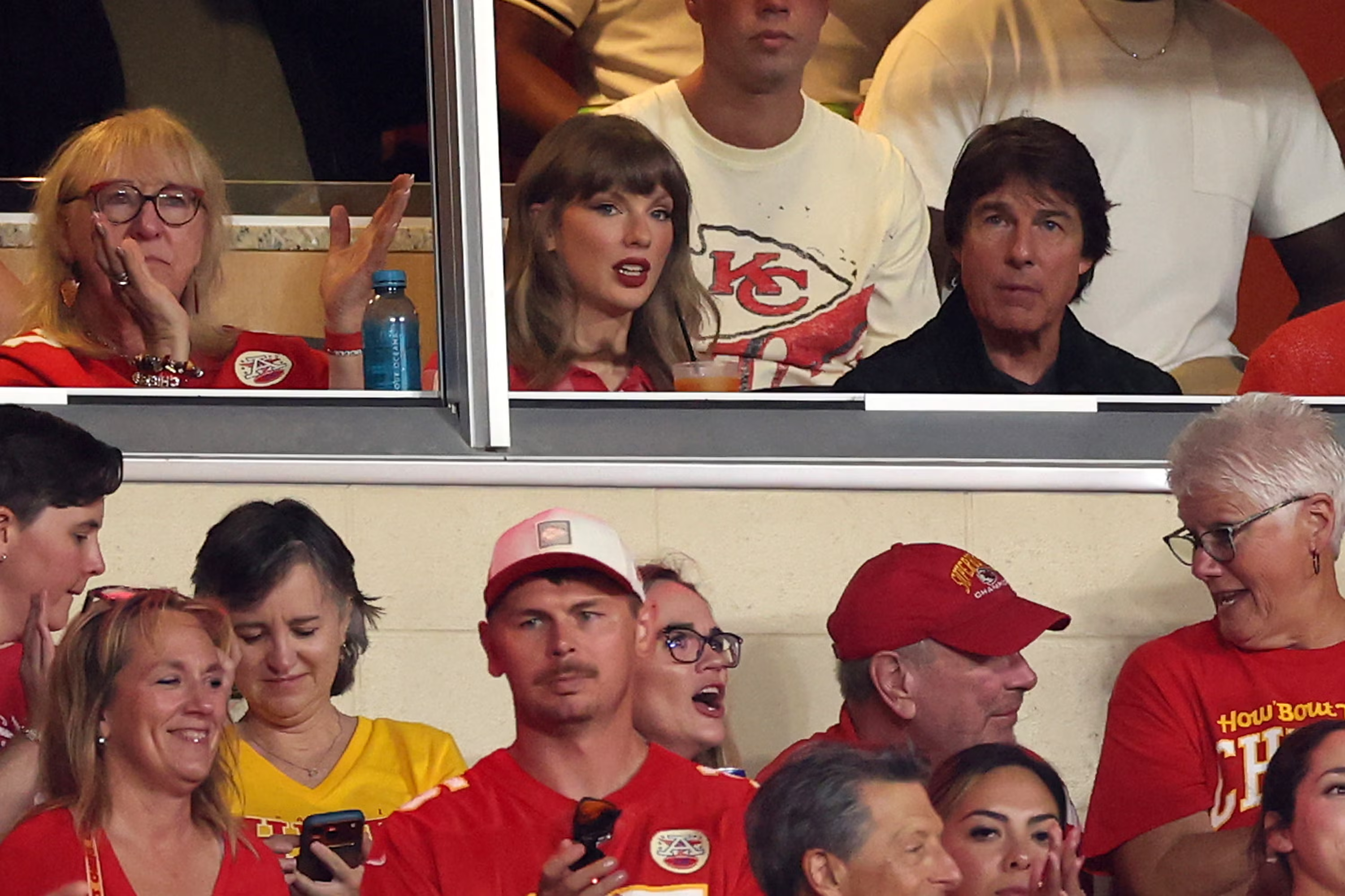
Tom Cruise ended speculation about his exchange with Taylor Swift at a Kansas City Chiefs game, putting to rest days of internet theories and amateur lip-reading attempts that had spawned countless memes and social media debates.
The pair were photographed together at Arrowhead Stadium, where Swift has been a frequent spectator supporting her boyfriend, Travis Kelce. Their interaction sparked immediate curiosity online, with viewers attempting to decipher their conversation through video clips. The lip-reading attempts proved wildly inaccurate, leading to humorous and absurd interpretations that circulated across TikTok and Twitter.
Cruise has now revealed the actual topic of their chat. Rather than discussing filmmaking, music, or any of the celebrity gossip theories that dominated social feeds, their conversation centered on a much simpler subject. The specifics of what was discussed remain grounded in ordinary celebrity mingling rather than headline-grabbing revelations.
This moment captures a broader pattern in celebrity culture. High-profile individuals cannot share a conversation at a public event without immediate scrutiny and speculation. The incident demonstrates how footage of celebrities interacting becomes instant fodder for public analysis and fabrication. Viewers with no actual sound access invent narratives based on mouth movements, often creating entirely fictional exchanges that then spread as "truth" across digital platforms.
Swift's visible presence at Chiefs games has become a cultural phenomenon in itself. Her attendance generates its own news cycle, complete with fashion analysis, stadium attendance records, and relationship commentary. The combination of Swift's massive fanbase, Cruise's Hollywood legacy, and the unpredictability of live stadium footage created the perfect storm for speculation.
The clarification serves as a useful reminder about the limitations of visual information without audio context. Lip-reading remains notoriously unreliable, especially in crowded environments with varying angles and lighting. Yet audiences continue to treat amateur lip-reading interpretations as credible evidence, sharing them as definitive fact.
Cruise's decision to address the speculation directly reflects how public figures now manage narrative control. Rather than allowing false interpretations to persist, celebrities increasingly step forward to set records straight. This approach acknowledges that in the social media age, allowing misinformation to circulate unchecked carries real consequences for public perception.
The incident also highlights the parasocial relationship many people maintain with celebrities. The assumption that a brief conversation between two famous people must contain something worthy of intense public scrutiny reveals how audiences project significance onto ordinary moments. Two people can chat at a sporting event without it representing a larger cultural moment or important collaboration.
Moving forward, this serves as a case study in celebrity privacy erosion and information verification. The hunger for celebrity content has created an ecosystem where speculation fills genuine knowledge gaps. Clarifications like Cruise's become necessary simply because audiences cannot resist attempting to decode every visible interaction between famous individuals.